The brain senses gravity,

(vestibular sensation)

interprets these signals,

(vestibular processing)

and transforms them into precise movements

(postural control & navigation)

We study how neurons & glia shape vestibular function
and how impairments lead to balance deficits

Why fish?

The sensation of balance, strategies to maintain it, and the underlying neuronal architecture have been conserved across vertebrates for over 500 million years. Long before trees appeared on land, fish were already swimming in the water, using their vestibular inner ear to sense orientation and maintain stability.

We use larval zebrafish to study balance. Beyond being adorable, they offer optical and genetic accessibility, allowing us to observe and manipulate the brain of an intact, live vertebrate. (And did we mention they're adorable?)
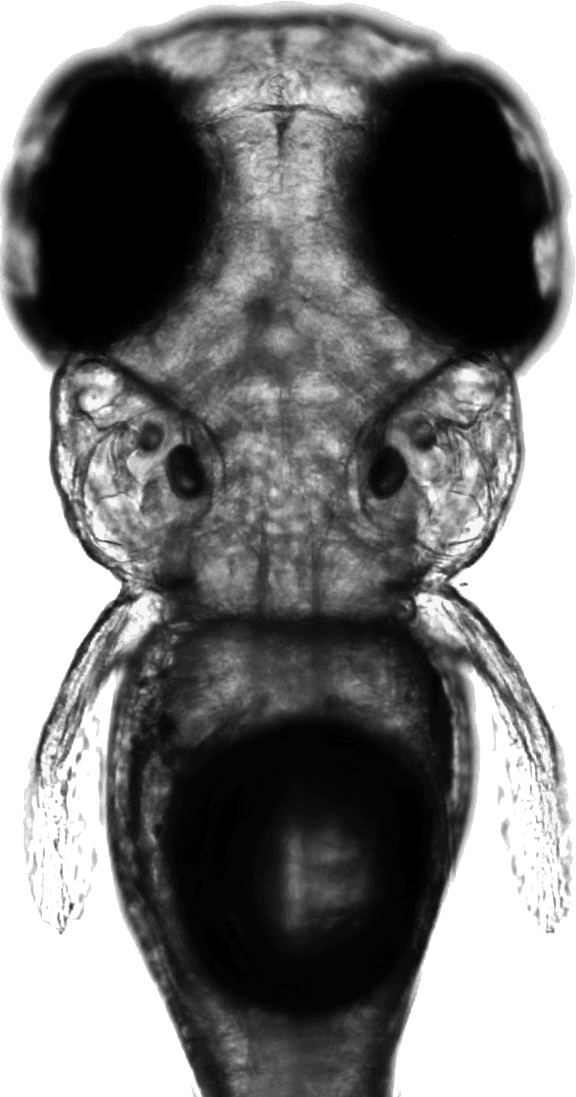
Bright field microscopic image of a zebrafish larva looking from the top.

A small, translucent vertebrate

A small, translucent vertebrate


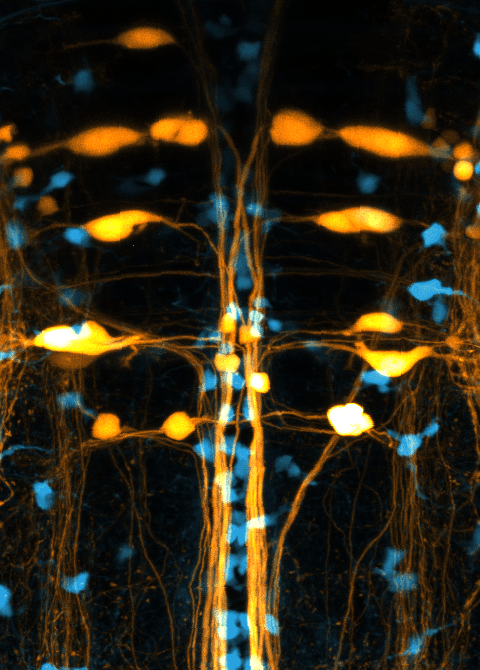
Fluorescent microscopic image of the hindbrain of a transgenic zebrafish larvae looking from the top.

Conserved brainstem architecture


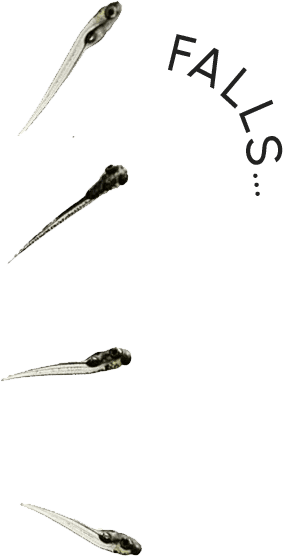
A fish larva rotates while falling in the water column.

Inherently unstable


We aim to understand how the brain interprets gravity, initiates movement, and stabilizes posture โ€“ ultimately, why we lose balance and how it can be restored.

We aim to understand how the brain interprets gravity, initiates movement, and stabilizes posture โ€“ ultimately, why we lose balance and how it can be restored.

We take a systematic approach,
studying balance at the molecular, cellular, circuit, and behavioral levels

We take a systematic approach,
studying balance at the molecular, cellular, circuit, and behavioral levels

We take a systematic approach,
studying balance at the molecular, cellular, circuit, and behavioral levels

Quantitative analysis of balance behavior

Fish swim to maintain postural stability and navigate the water column. We've built the SAMPL apparatus to measure posture and locomotion with high spacial and temporal resolution.
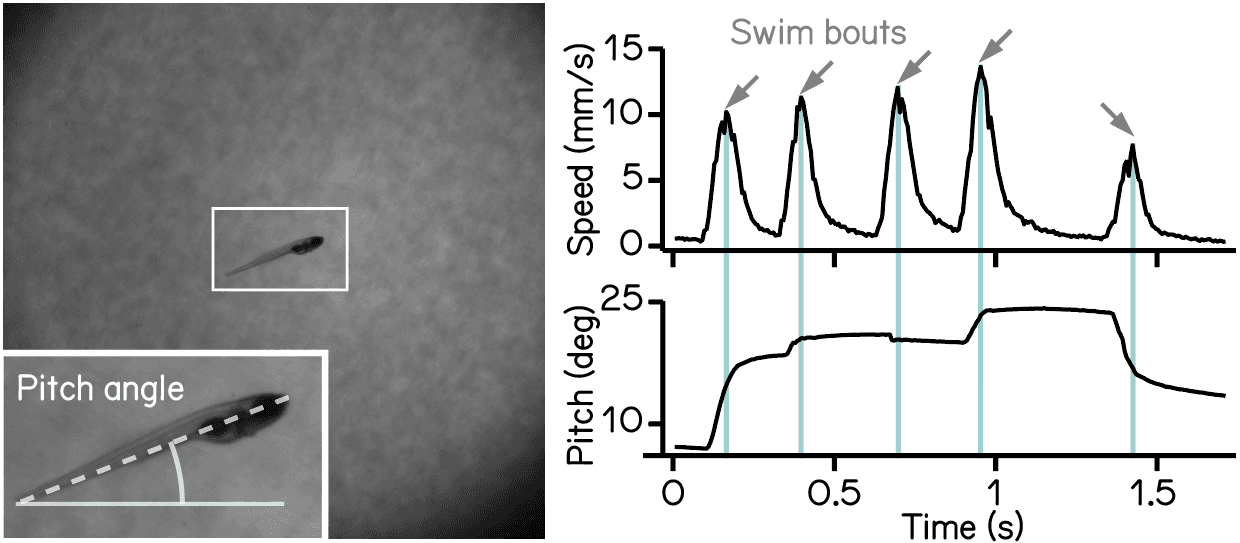
Analysis of swim bouts of zebrafish larvae.
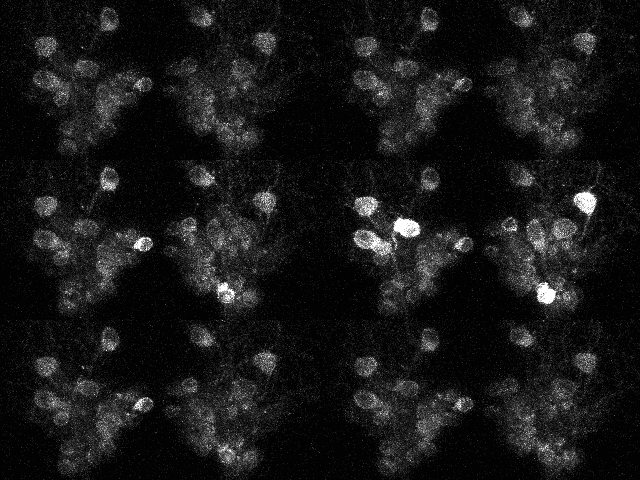
Movie showing calcium activity of neurons in zebrafish brain.

Measuring circuit activity

Transgenically modified fish allows us to watch neuronal (and glial) responses to body tilts! We use TIPM, a setup that tilts larval zebrafish under a 2-photon microscope, to understand how the brain encodes, processes, and transforms gravity signals.

Live imaging of brain development and cell death

We use time-lapse microscopy to watch biology unfold: neurons emerge and migrate; glia move, wrap, and remodel, doing their wild glial stuff; circuits assemble and refine, forming functional networks.

We also model disease conditions, capturing cell death and inflammation, and ask how circuit function might be restored.
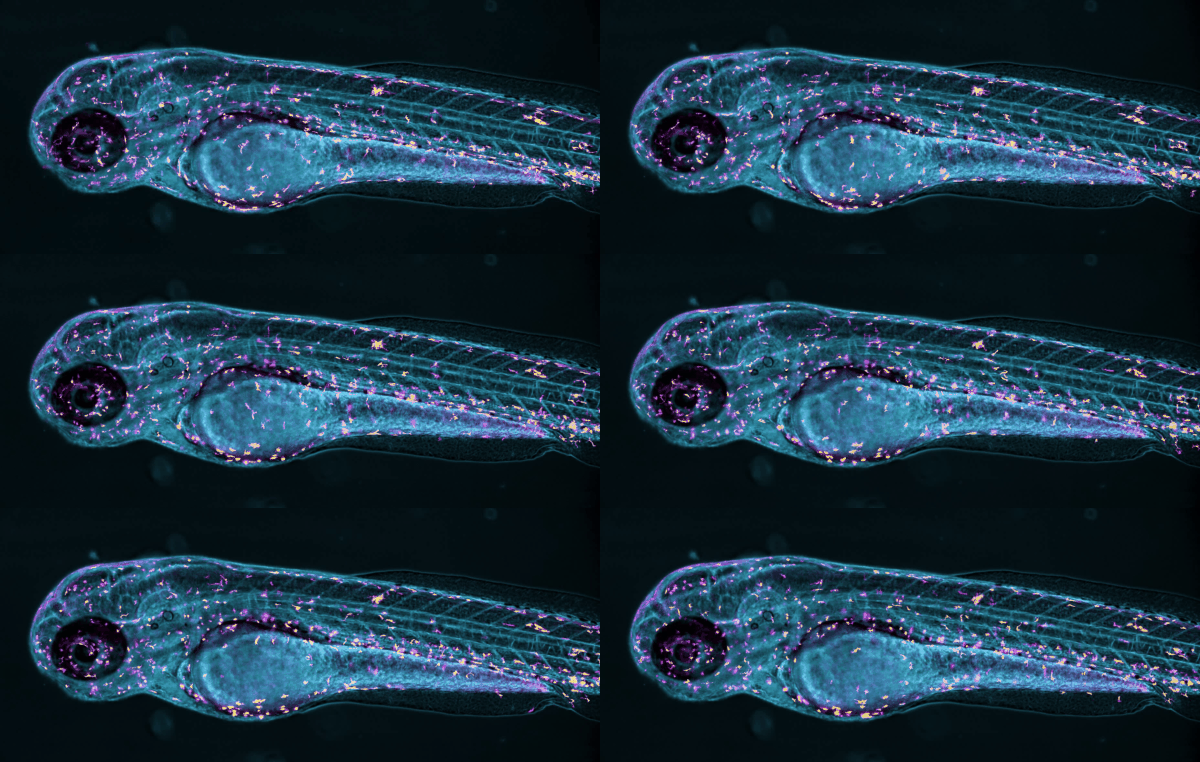
Movie showing macrophages and microglia migrating in the whole body of a live zebrafish larvae.
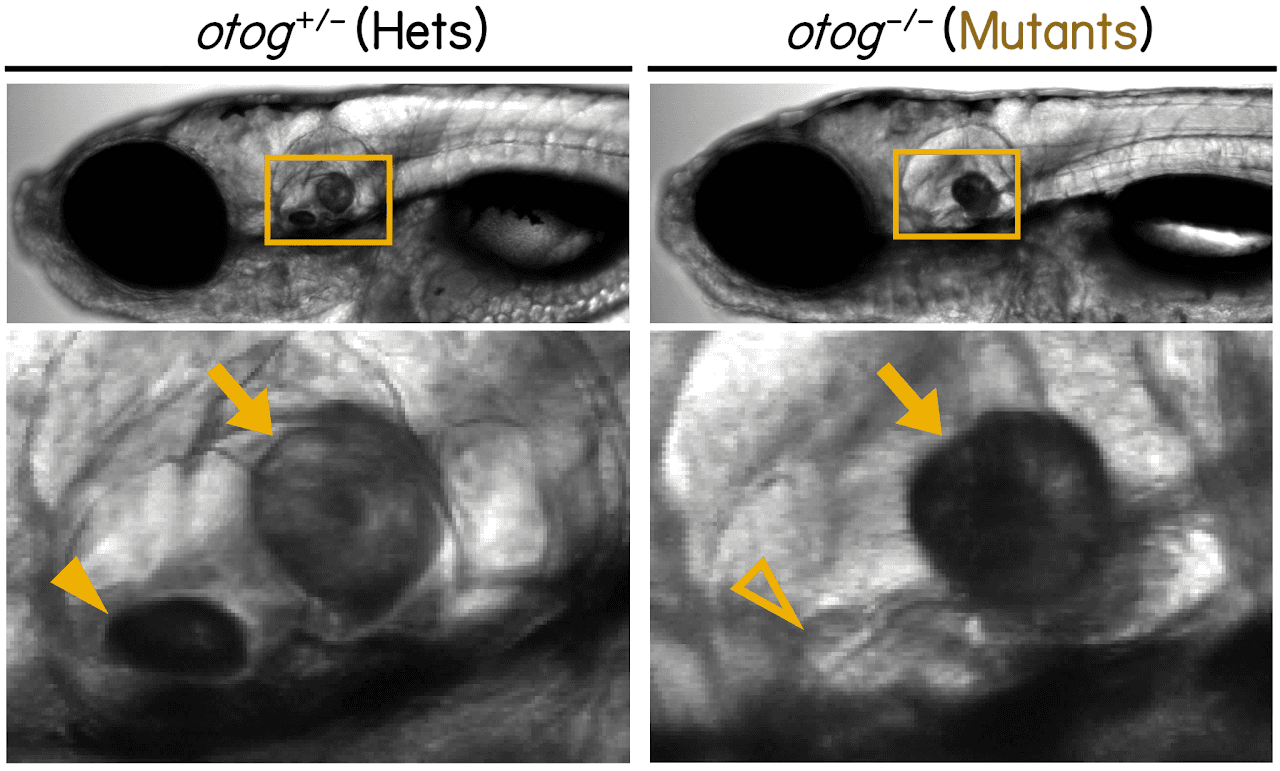
Images showing the otoliths in the inner ear of zebrafish larvae

Genetic mutation that makes fish gravity-blind

We study the molecular players involved in gravity interpretation. One example is the otogelin gene: when it is lost, larvae fail to form the anterior otolith (ear stone, arrow head in the image) in the inner ear โ€” the structure responsible for sensing gravity. These fish are essentially gravity-blind for the first two weeks of life!

Genetic mutation that makes fish gravity-blind

We study the molecular players involved in gravity interpretation. One example is the otogelin gene: when it is lost, larvae fail to form the anterior otolith (ear stone, arrow head in the image) in the inner ear โ€“ the structure responsible for sensing gravity. These fish are essentially gravity-blind for the first two weeks of life!

Hiring at all levels starts in 2026!